
Showing Up and Speaking Out: Julie Peck’s Advocacy in Southwest Virginia
By, Teresa Wilson-Kennedy*
“If not me, then who?” is a question that has inspired countless people to answer a call to service, particularly those in the military and emergency services. Julie Peck’s version is more literal: she says if she doesn’t try to fix what’s hurting her community, no one will, and nothing will change. Julie’s service doesn’t come with the same visibility or the same ‘thank you for your service’—but it should.
“Somebody’s got to make some changes in this area. And if I have the ability to do it, why not do it?” Julie shrugs as she speaks, as if two decades spent confronting some of the most difficult, and often hidden human experiences—substance addiction, especially among pregnant and postpartum mothers, and the grief of losing a baby—were no big deal.
Julie has a calming presence, a kind smile, and a strong Appalachian accent. Minutes into our video call, she apologized for looking frazzled; she’d just come from her day job to speak to me for this story. She wanted to make sure I felt comfortable, and I did. I understood immediately how Julie had built such trust across her community.
Born and raised in Russell County, which Julie calls the “far southwest” tip of Virginia, she is careful to note that it’s distinct from other “southwestern” counties like Roanoke. She says folks there are used to being ignored by Washington and Richmond and often treated as out of sight and out of mind. “There’s so much that needs to be changed down this way, and I don’t know how, but it’s gonna happen one day.” The change, it seems, will come from Julie and people like her who are stepping up.
Julie’s day job, which far exceeds a typical 9-to-5, is serving as a peer navigator for the national HEALthy Brain and Child Development (HBCD) study, the largest long-term study of early brain and child development in U.S. history. More than 7,000 families nationwide are participating in medical evaluations that track how substance use and other biological factors during pregnancy and early childhood affect how an infant’s brain develops during that time.
It’s also one of the first times Southwest Virginians have been included in a large medical study of this scale, Julie said. She uses this point to recruit women participants in a community where many are wary of public health interventions, especially after the disinformation spread during the COVID-19 pandemic. She tells them that participating in the study is a rare opportunity and that they can tell their children they helped make the world better through research.
Of the roughly 250 Virginia families enrolled through Virginia Tech, Julie is responsible for shepherding 100 of them through the study: driving mothers and children across the state to appointments and interviews, conducting the study’s questionnaires, recruiting eligible participants, and providing general support as a trusted peer. It also means supporting pregnant and postpartum mothers through recovery from substance abuse. Julie marked 20 years of her own recovery this month. Her husband, whom she credits with getting her into treatment, has been in recovery for 26 years.
Julie’s own history with substance use disorder makes her an invaluable ally and advocate for other mothers in recovery—and once they learn she understands firsthand, they begin to open up. Talking about addiction openly is a vital step toward recovery, she said. For a long time, the culture in Southwest Virginia was to hide it, and that secrecy and silence made recovery much harder.
Following years of being silent, Julie decided to speak out about the hard things after her son died of sudden infant death syndrome (SIDS) at three months old. Realizing that losing a child was another dark part of life that no one really talked about, Julie discovered an online community for people grieving, and she threw herself into it: “I went from someone needing support to supporting others, and I never looked back.”
Julie quickly discovered that she wanted to offer the same kind of support to her local community, so she trained to become a certified birth and death doula. Soon, people in Russell County would call her if they knew someone who had lost a baby and didn’t know what to say or do. Julie knew what to do—and she showed up to help.
Over time, she realized she could offer the same kind of help to people dealing with substance addiction and led a support group at her local methadone clinic. Julie found that she could be the one to fill the support roles in the community that she never had. “I don’t have to be anyone important; I just have to be there and show up,” she said. “Anywhere, everywhere I can, I will show up.”
In addition to being a pillar of support for bereavement and addiction in her community, Julie advocates for resources and policy changes to improve lives across the region. She chairs the pregnancy and postpartum group of the Appalachian Substance Abuse Coalition, which represents 13 counties in Southwest Virginia across prevention, treatment, recovery, and support. She has spoken to the media about her own experience being pregnant while in substance abuse treatment and the policies that affected the healthcare she received.
In February, Julie shared her story and her experience with mothers battling addiction with lawmakers in testimony submitted to the General Assembly in support of Senate Bill 133. The bill would require state agencies to re-evaluate whether Virginia law discourages mothers in treatment from seeking prenatal care for fear of triggering a mandatory referral to Child Protective Services or other punishment.
Since Julie’s responsibilities to more than 100 mothers in the HBCD study made the five-hour drive from Russell County to Richmond impractical, Julie’s testimony was read to legislators by Kathryn Haines, health equity manager for the Virginia Interfaith Center for Public Policy (VICPP). In it, Julie described the toll current law takes on maternal health in her community:
“I have seen many individuals over the years who have chosen not to seek medical care during pregnancy for fear of losing the life they already love so dearly, growing inside of them. Some choose to pay out of pocket at a private facility for their ultrasound to prevent them from having to go through an OB doctor for fear of being reported. Others have chosen to use other alternatives, like using illicit substances to keep them from getting in trouble from medication-assisted treatment. Of course, this is not good for mother or baby; it can be deadly. We shouldn’t punish mothers and families just because the parent seeks help through treatment.”
Gov. Abigail Spanberger signed the bill into law this past April. It requires state agencies, in consultation with nongovernmental stakeholders, including the Virginia Interfaith Center, to submit a report of findings to the General Assembly by December.
Julie’s long-term goal for Russell County and the rest of Southwest Virginia is to establish recovery housing for women in treatment and recovery: housing for pregnant mothers and secondary housing for newly postpartum mothers and their babies. She believes that the more she talks about the need, the more support she can build—the same way she’s filled other gaps in her community.
When asked how she does all this—Julie’s also a mother of five—she said she just takes it one day at a time. Then, with a grin, she added, “It really helps to hammer the crap out of something!”
Even her stress relief serves others: Julie runs a small jewelry-making business called Jewels Perfect Imperfections, which she started during her time as a bereavement doula to create jewelry to memorialize the babies that the mothers she supported had lost.
“I wanted to be able to give this community someone that could help them,” she said. “I got really tired of being the quiet person and decided that it was better that I opened my mouth.”
Russell County is better for it. And so is Virginia, with the passage of this bill and the other changes the report will bring. Julie’s work offers many lessons for advocacy, but one of the strongest is this: There is power in simply showing up and speaking out.
*Teresa Wilson-Kennedy is a proud Richmond resident with over a decade of experience in public policy development and implementation. She is a member of St. Stephen’s Episcopal Church and a firm believer in the power of public policy as a force for good.
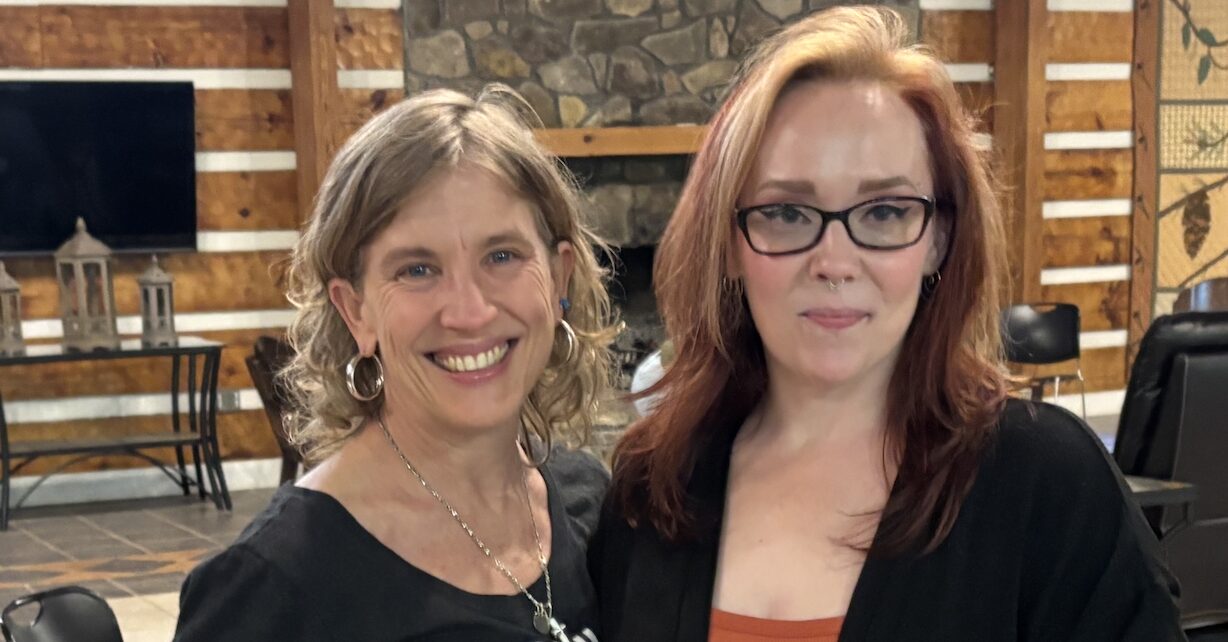
Photo: L-R: Kathryn Haines, VICPP’s health equity manager, and Julie Peck at the Community Health Worker Doula Midwife Cohort retreat that VICPP leads in May, 2026